About BGDS Puzzles
Grid minds think alike.
Why do we enjoy solving logic puzzles? Probably not because filling in numbers or coloring cells is so exciting. The real fun begins when we notice a connection we hadn't seen before. When we finally understand why a certain number can only go in one particular cell. And of course, there's that satisfying moment when the last number falls into place after half an hour of thinking.
BGDS Puzzles is built around that experience. The project has several parts. You can play logic puzzles here on our website, buy our books on Amazon, or watch complete puzzle walkthroughs with explanations on our YouTube channel. We're also working on mobile apps, which are currently under development.
Logic, Not Erasing
BGDS Puzzles currently offers eight logic puzzle games: Nurikabe, Hitori, Futoshiki, Akari, Tents, Jigsaw Sudoku, Sudoku, and Takuzu. You don't need to guess to solve these puzzles. Every correct step can be found through logical reasoning and by applying the rules of the game. We also use these deductive rules to generate the puzzles. This ensures that each puzzle has exactly one correct solution, which can be reached without guessing or backtracking.
Thomas Snyder, a multiple-time World Sudoku Champion, shared an interesting thought about logic puzzles in a 2013 article:
"When I can solve a puzzle in ink, without erasures…"
Snyder makes a distinction between logical reasoning and trial and error. This doesn't mean we should be able to spot every step immediately. Recognizing a more advanced rule can take a lot of thought. The important thing is that we don't need to make random guesses and then undo them when we reach a dead end.
Let's look at a situation where a solving technique isn't easy to spot at first. This example comes from our Sudoku Fundamentals book. The rule used here is called Pointing Cells. It's an elimination technique. Instead of placing a new number immediately, we remove certain possibilities from some cells.
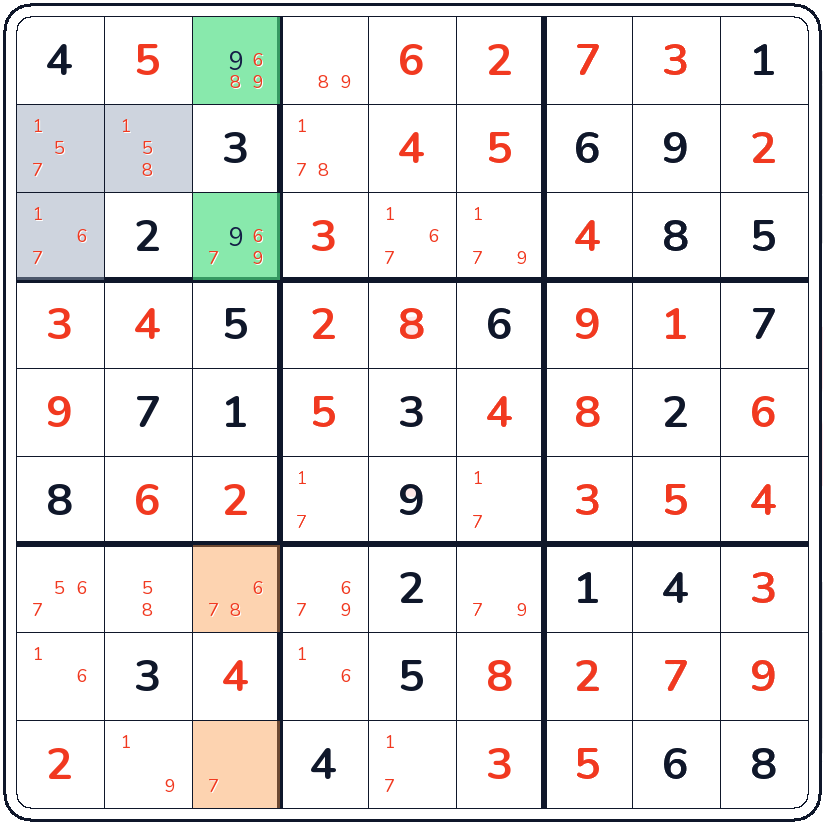
In the top-left 3×3 box, the number 9 can only go in the two green cells. We've already ruled out 9 from every other cell in that box. Both green cells are also in the same column. This means that the 9 for that column must be placed somewhere inside the top-left box. We can therefore eliminate 9 from the orange cells farther down the column. If we placed a 9 anywhere else in that column, both green cells would be blocked, leaving no place for a 9 in the top-left box.
This step only eliminates possibilities, but it has an important result. One of the orange cells near the bottom previously had two possible values: 7 and 9. Once Pointing Cells eliminates 9, only 7 remains. So a logical rule that wasn't easy to recognize has led us to a number we can place with certainty.
This example shows that even applying a single logical rule can require careful thought. And Pointing Cells is just one of many Sudoku solving techniques. Puzzle difficulty doesn't necessarily depend on grid size. A larger puzzle can be easy if it only requires basic rules. On the other hand, a smaller grid can be quite challenging if it requires more advanced reasoning. That's why, when we rate the difficulty of puzzles at BGDS Puzzles, we mainly consider how complex the rules needed to solve them are.
Every puzzle we generate goes through a two-step validation process. First, we check whether it can be solved using only Easy-level techniques. If it can, we classify it as Easy. If not, we test it with more advanced techniques.
A puzzle is classified as Hard only if at least one Hard-level technique is actually required to solve it. Simply being able to use an advanced technique doesn't make a puzzle difficult.
It's the techniques you need, not the size of the grid, that determine the difficulty.
YouTube – Not Just the Solution, but How to Get There
When we get stuck on a puzzle, we can usually find two kinds of help. One shows us the completed solution, while the other explains a few important steps. Both can be useful, but we wanted to offer something more. On the BGDS Puzzles YouTube channel, we publish complete walkthrough videos generated automatically by our own puzzle solver. These videos show the entire solving process, from the first step to the last, with explanations for every step.
There is, however, an important difference between how our program works and how people normally solve puzzles. When solving a puzzle, a person usually focuses on an area where they notice something interesting. One step often leads to another idea, so they continue working in the same area. Our program works differently. It uses processing rounds, going through all the known solving rules in each round. It applies each rule as many times as possible before moving on to the next one. Once all the rules have been checked, a new round begins.
Because of this, the order of steps in our videos may sometimes seem unusual. For example, the program might fill in several cells in completely different parts of the grid using a simple rule before moving on to a more advanced one. A person probably wouldn't follow exactly the same order. However, every puzzle has only one correct solution, even though there may be several ways to reach it. Deductive rules ensure that, regardless of the order we follow, correct logical steps will always lead to the same result. Our videos aren't meant to copy the way people think. Their purpose is to show the complete logical process, so viewers can understand how one step leads to the next.
You can watch the videos on our BGDS Puzzles YouTube channel.
Puzzle Books – For Those Who Prefer Paper
Digital puzzles are convenient, but many people still prefer solving them on paper. You can take a book anywhere, you don't need an internet connection, and of course, its battery will never run out. That's why BGDS Puzzles also offers a growing collection of puzzle books on Amazon. The puzzles in our books come from the same database as our online games. However, our different book series are designed for different purposes.
The Fundamentals books are for people who want to learn the rules of a game and understand its solving techniques. The Workbook series provides exercises to practice those techniques. We also publish traditional puzzle collections at different difficulty levels. Our Daily and Weekly series are designed for people who enjoy solving puzzles regularly. Some people like to solve a puzzle every morning with their coffee. Others prefer spending more time on a difficult puzzle over the weekend. We select different numbers and difficulty levels of puzzles for each type of book.
We regularly add new books to Amazon, and we're planning more titles alongside our existing series. We don't want to limit our collection to just one type of puzzle book. Someone who is just discovering Nurikabe needs a very different book from someone who has been solving difficult puzzles for years. Our large puzzle database allows us to create books for both groups.
Online Games and Upcoming Mobile Apps
You can play our games directly on this website without installing anything. But for those who prefer playing on their phones, we're also developing mobile apps. These are currently under development and will be available for free. We plan to support them through advertising, but how those ads appear matters to us. There's nothing more annoying than being interrupted by an advertisement just when you're working through a difficult logical problem.
That's why we're planning two types of advertising. Regular ads won't interrupt your game, and there will be at least five minutes between them. Some extra features, however, will require watching an ad. These include getting help with the next logical step (hint) or sharing your own puzzle walkthrough. You can decide whether you want to use these features. If you do, you watch an ad and get access to the selected feature in return. This is known as rewarded advertising.
The walkthrough sharing feature deserves a little more explanation. In most logic puzzle games, sharing means sending an image of the completed grid, sometimes together with your solving time. At BGDS Puzzles, however, you'll be able to share your entire walkthrough, not just the final result. This means showing which steps you took and the order in which you reached the solution. That's much more interesting than a simple screenshot, because two people can solve exactly the same puzzle in very different ways.
Think about it. You finish a difficult puzzle and then watch how someone else solved it. Maybe they spotted a connection right away that took you much longer to notice. Or perhaps you found a faster way to reach the solution. We can learn a lot from these differences, and that's exactly what we want to make possible with shareable walkthroughs.
Grid Minds Think Alike.
BGDS Puzzles is more than just a website offering logic puzzles. Our books, videos, and apps complement each other. You can play a puzzle in your browser, find it in one of our books, or watch its complete solution on YouTube. Our upcoming mobile apps will offer even more ways to play and share different solving techniques.
Whether you're looking for a few minutes of relaxation or want to spend hours working on a difficult puzzle, the satisfaction comes from the same place. It's that moment when a connection you couldn't see before suddenly becomes clear, and you know exactly what your next step should be.
Grid minds think alike.